
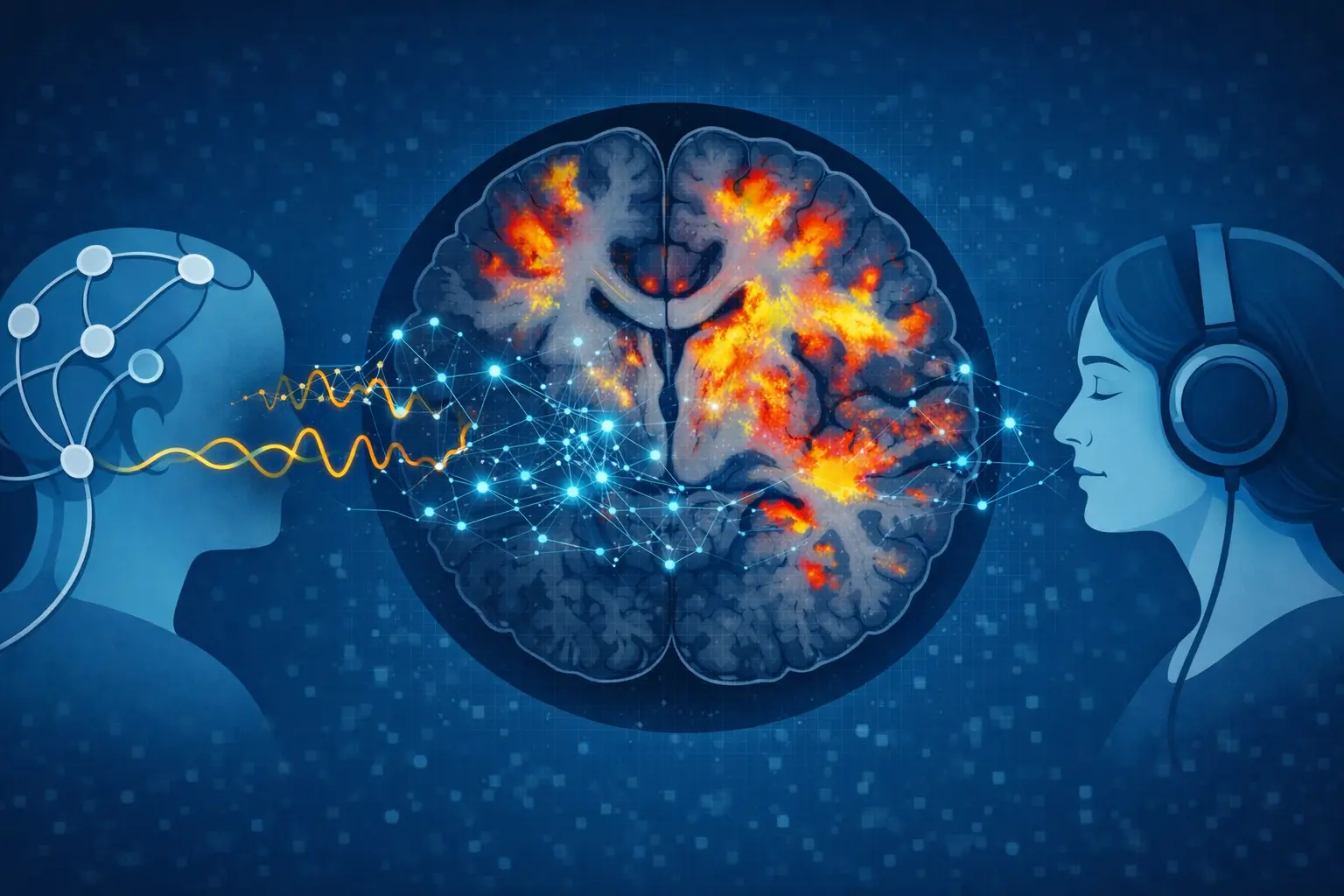
ILF neurofeedback receives mechanistic validation in a NeuroImage study
A new study in NeuroImage provides a mechanistic basis for ILF neurofeedback.
The fMRI study shows stable changes in brain networks only for the full ILF protocol.
Neurofeedback has been used in clinical practice for many years. At the same time, there are ongoing discussions about the neurophysiological mechanisms through which different neurofeedback approaches exert their effects. In the case of infra-low frequency (ILF) neurofeedback, imaging studies demonstrating objective changes in the brain beyond subjective reports have so far been limited.
A study published in December 2025 in the scientific journal NeuroImage addresses this gap. The aim of the paper was not to evaluate the clinical efficacy of neurofeedback, but to investigate the neurophysiological effects of the signal components of a well-established ILF protocol from a mechanistic perspective.
ILF neurofeedback as a combined approach
ILF neurofeedback is not a method based on a single signal. It is based on the combination of multiple EEG time-based measures, including:
- classical EEG frequency band signals that reflect rapid neuronal dynamics
- infra-low signals that capture very slow regulatory processes
This combination corresponds to the clinical ILF configuration used in therapeutic practice.
To better understand the underlying mechanisms, the signal components combined in ILF neurofeedback were deliberately analyzed separately in the study and examined both individually and in combination. This separation served the mechanistic investigation of the well-established ILF approach.
Study design: mechanistic analysis of an established protocol
The study included three randomized, double-blind, placebo-controlled cross-over experiments with a total of 135 healthy participants. In each sub-study, participants completed a single 30-minute neurofeedback session, accompanied by fMRI measurements before and after the session.
Three experimental conditions were examined:
- classical EEG frequency band signals alone
- infra-low signals alone
- the combination of frequency band signals and infra-low signals, corresponding to the clinical ILF configuration
The resting-state fMRI data were analyzed using multivariate functional connectivity pattern analysis (fc-MVPA), an established method for evaluating large-scale brain networks.
Main results
The central finding of the study is clear: robust and statistically significant changes in functional brain connectivity were observed only when the frequency band signals and the infra-low signals were applied in combination. When the individual signal components were applied in isolation, no comparably stable effects were observed after statistical correction.
The results therefore indicate that consistent neurophysiological changes occur numai din combinația diferitelor masuratori temporale EEGThe study does not identify a new combination, but demonstrates the neurophysiological relevance of the full ILF neurofeedback protocol as it is used in clinical practice.
Relevance of the findings for BEE Medic’s ILF neurofeedback
For the first time, the results provide an imaging-based mechanistic foundation for the ILF approach, which BEE Medic has exclusively developed and technically implemented in this consistent clinical configuration. The study shows that the observed effects are not determined by individual EEG signals, but by the targeted coupling of rapid and very slow neural dynamicsas implemented in ILF neurofeedback. In this way, an approach that was previously shaped primarily by clinical experience is now grounded in a clear neurophysiological basis.
Study context
The study is designed as fundamental neurophysiological research. It does not make claims about clinical efficacy, specific symptoms, or long-term effects. Its contribution lies in the objective, imaging-based analysis of the underlying mechanisms.
Conclusion
The fMRI study published in NeuroImage demonstrates that the full ILF neurofeedback protocol—i.e., the combination of classical EEG frequency band signals and infra-low signals—leads to stable and measurable changes in functional brain networks. The study thus provides, for the first time, a an imaging-based mechanistic foundation for the ILF approach as it is used clinically and technically implemented through BEE Medic devices.
References
https://beemedic.com/en/new-neuroimage-study-provides-mechanistic-foundation-ilf-neurofeedback
https://www.sciencedirect.com/science/article/pii/S1053811925006500




 EN
EN  RO
RO